

Constant Temperature Mixing & Diverting Control for Heating Systems
Low-Temperature Return & Temperature Fluctuation Control for Boiler and Radiator Systems
In conventional heating systems, there is often a conflict in temperature requirements between the heat source (e.g., boilers) and the terminal units (e.g., radiators). For instance, to prevent condensation and corrosion in boilers, the return water temperature must remain above the dew point (typically requiring a constant temperature above 50°C), whereas terminal radiators may require lower supply temperatures.
Traditional electric mixing systems rely on complex sensors and controllers, which pose risks of response lag and component failure. The Wenning™ Return Bypass Valve offers a purely mechanical solution based on physical principles.
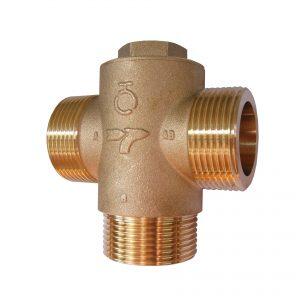
TM Series Self-Acting Three-Way Thermostatic Valve
The TM Series is a preset, self-acting three-way thermostatic valve. Utilizing a built-in thermal element (requiring no external power), it directly senses changes in medium temperature. It mechanically actuates the valve core to proportionally regulate or switch the flow direction between two outlets.
Core Control Logic
Constant Temperature Mixing Control
Mixes high-temperature source water with low-temperature return water within the valve body in a specific ratio to output a constant intermediate temperature, supplying terminal radiators or process equipment.
Constant Temperature Diverting Control
Automatically selects flow direction based on water temperature. It allows direct circulation at low temperatures and diverts flow to radiators at high temperatures; alternatively, it creates a bypass at the boiler return port to ensure a constant return water temperature entering the boiler.
Shut-off Protection Logic
The valve features a shut-off function at set temperatures. For example, with a 45°C setting, when the temperature rises to approximately 48°C, the high-temperature inlet branch (B-AB branch) automatically closes to prevent overheating, and restores automatically upon cooling.
Applicable Fields & Scenarios
Core Application Scenarios: Boiler protection and radiator constant temperature control for indoor heating applications including electric boilers, wall-hung boilers, heat pumps, and solar systems.
Boiler Return Water Protection System
Functions as a return temperature protection valve in condensing or traditional boiler systems. When the return water temperature is too low, it cuts off the direct return path and forces water to mix with high-temperature supply water via the bypass. This raises the return temperature, preventing condensation corrosion caused by low-temperature return water and extending equipment life.
Radiator Constant Temperature Water Supply System
Acts as a mixing center when connecting high-temperature heat sources (e.g., coal/gas boilers) to low-temperature radiators (e.g., underfloor heating/fan coils). It mixes high-temperature supply water with low-temperature return water to provide a constant low-temperature supply (e.g., 45°C/55°C/65°C) to the terminals, achieving decoupling between the heat source and the terminals.
Industrial Process Temperature Control
Suitable for industrial cleaning, preheating, and other processes requiring constant fluid temperature.
Technical Specifications
| Parameter | TM25 Series | TM32 Series |
|---|---|---|
| Model Number | TM25-45 / TM25-55 / TM25-65 | TM32-45 / TM32-55 / TM32-65 |
| Nominal Diameter | DN25 (1″) | DN32 (1 1/4″) |
| Valve Body Material | Brass | Brass |
| Temperature Setting | 45°C ±3 / 55°C ±3 / 65°C ±3 | 45°C ±3 / 55°C ±3 / 65°C ±3 |
| Max. Pressure Differential | 0.5 bar | 0.5 bar |
| Flow Coefficient (Kv) | 10 m³/h | 10 m³/h |
| Max. Working Pressure | 1.6 MPa | 1.6 MPa |
| Max. Medium Temperature | 95°C | 95°C |
| Weight | 692 g | 700 g |
System Integration Logic
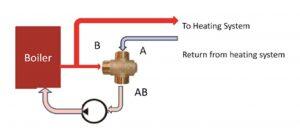
Scenario 1: Boiler Low-Temperature Protection
- Input: High-Temperature Supply (Port B) + Low-Temperature Return (Port A)
- Logic: When the mixed return water temperature falls below the setpoint (e.g., 55°C), the valve automatically modulates to mix in a portion of the high-temperature supply water, thereby raising the return temperature. When the temperature meets the standard, it automatically reduces the mixing volume.
- Output: Constant temperature return water enters the boiler (Port AB).
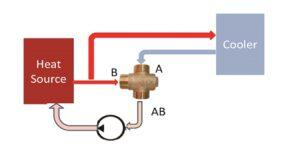
Scenario 2: Radiator Constant Temperature
- Input: High-Temperature Heat Source (Port B) + System Return (Port A)
- Logic: Based on the set temperature (e.g., 45°C), the valve automatically adjusts the mixing ratio between the high-temperature water and the return water.
- Output: Constant temperature supply water is delivered to the radiators (Port AB).
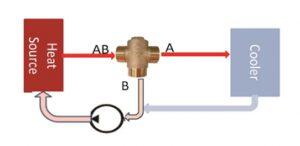
Scenario 3: Boiler Cold Start & Rapid Preheating
- Input: High-Temperature Heat Source (Port AB) + Bypass Return (Port B)
- Logic: Based on the set temperature (e.g., 45°C), the valve automatically regulates flow direction. Low-temperature water from the heat source enters the valve via Port AB and is forced to direct towards Port B (bypass loop), returning directly to the heat source return port or circulation pump inlet. When the heat source outlet temperature rises and reaches the valve’s setpoint, the thermal element expands due to heat, pushing the valve core to gradually open Port A and close Port B, allowing the system to smoothly transition to normal heating mode.
- Output: Constant temperature supply water is delivered to the radiators (Port A).
Beijing Winning™ Thermo Control Equipment Co., Ltd.
Dedicated to technology research and development (R&D) and product manufacturing in the field of fluid temperature control.
We provide customization services for special temperature settings. Please feel free to contact our engineering team for inquiries.